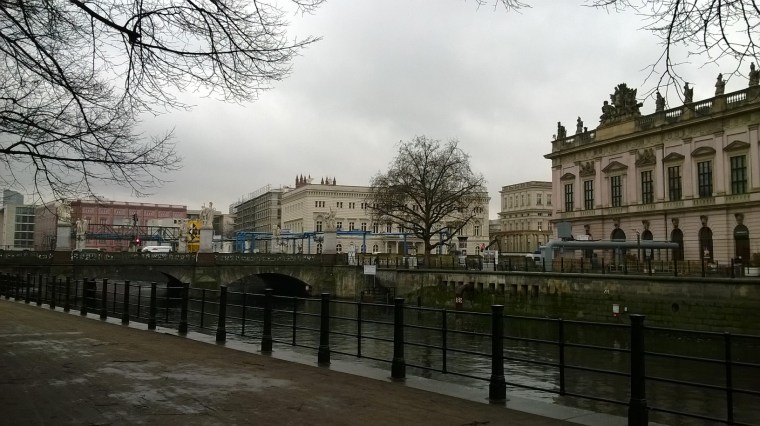
Mitte: Sophienstraße

Until a few years ago I had a romantic fantasy about my future. I would have a good job and earn quite a lot money (because that is so typical for Berlin!) and live in a wonderful big flat in Sophienstraße in Mitte.

When I’d come home from work with my beautiful black Peugeot ladies’ bicycle (which actually existed when I started having this fantasy) I would stop at the small pralines and chocolates shop and buy handmade pralines to surprise my two children when they come home from ballet and violin class. After a family dinner in our big living room we would cuddle up in front of the (for my sake fake) fireplace, enjoy the chocolates and tea and I would read stories to my children until they’d fall asleep. My husband and I would switch to red wine and talk about our wonderful jobs and plans for the weekend.

On the weekends I would buy fresh vegetables on the farmer’s market at Hackescher Markt, carry everything home in a basket and cook wonderful meals. Every Sunday we’d play games, make trips to the countryside or meet the rest of the family.

Nothing of all this has ever come true. No husband, no children, no flat in Mitte. I do not even cook very well, and on the weekends I order pizza and try not to leave the house. My black Peugeot bicycle has been stolen in Prenzlauer Berg years ago.

But when I’m around Sophienstraße I still think of that sketch of a fairy tale life and feel good about it, because dreams do not always have to come true. Keep them as long as they serve a purpose!

gruß, heike.

Charlottenburg: Windburger

Whenever I go to one of the districts that formerly used to belong to West Berlin, I get the feeling that I am going on a time travel. I sense that former West Berlin has been neglected pretty much since the Wall came down. Of course a lot of help and restoration were necessary in the Eastern parts, but that also means that in other districts Berlin hasn’t changed too much since 26 years except for what we call City West which is the area around Zoologischer Garten and Ku’damm. Don’t get me wrong. I have no problem with that. It just attracts my attention at times. And of course this circumstance contributes the difference between all the boroughs of Berlin and makes the city yet so interesting.

A few days ago I have been to Charlottenburg. This district is quite big and the home of e.g. Charlottenburg Palace with its wonderful gardens and some pretty cool museums and theatres. People that live in Charlottenburg have good jobs, like antiques and go to the theatre and ballet rather than to the cinema (except stuff like original versions in the Cinèma de Paris maybe). Some places seem a bit run down, but still proud of the long history of a district that was incorporated in 1920 being a large town already. There are a lot of small and cute shops that sell arts, antiques and rummage, delis that sell wine, chocolate truffles and Italian specialties and also quite a few galleries.

In the western parts everything seems bigger to me. The streets seem bigger, even the buildings seem bigger, while in the eastern part everything is divided into small sections and the streets and buildings seem smaller. (Although I am pretty sure I must be mistaken. I mean, how could this be possible?) If I give some thought to it, there might be several reasons, the first of which does not have anything to do with an unequal development after the Fall of the Wall but long before. Both Charlottenburg (former West) and Prenzlauer Berg (former East) for example have old buildings. Prenzlauer Berg is dominated by old buildings many of which derive from around 1900. But it has a short history as a housing area compared to Charlottenburg. A lot of houses were built after a couple of master plans in a short time (especially from 1889 to 1905) in Prenzlauer Berg because Berlin was growing and people needed space. So it was adopted first and then covered with buildings. Charlottenburg in contrast had been developing and expanding as a town of its own for centuries before it was added to Berlin. So it brought the structure of a complete town with it whereas Prenzlauer Berg was transformed from an agrarian spot into one with houses when needed.

The second reason might be that after 1990 the former East was more attractive to investors because the properties weren’t expensive and there were a lot of them. So we had a lot more construction activity here than in other parts of the city.

The third reason might be that old houses in e.g. Charlottenburg still have their old plastering whereas in Prenzlauer Berg we have smoothed fronts which are furthermore coloured. So a row of red, green and blue houses with smoothened facades might look smaller than those with stucco in light yellow and white.

So… these thoughts in mind I lingered around Stuttgarter Platz the other day, which is one of those parts I do not go to very often because I do not feel too comfortable there. But then the good thing about Berlin is that even if you’re in a place you do not want to stay or don’t feel comfortable with, you just turn around the next corner and might end up in a whole different world. And just around a corner in Windscheidstraße you will find the small place of refuge you might have been looking for: the Windburger. Food places in Berlin tend to be named after the street they’re located, so that’s where the name originates from.

The Windburger is a small burger restaurant with about room for twenty people. You get in, order your burger at the counter, pay and get a pager that lets you know when your burger is ready. There is a big variety of burgers, of course also veggie and different sizes. But another thing you do not want to miss is the homemade fries.

The little snack bar has yet another special feature. Every time I get there they play 90’s music. As a German I know that the whole rest of the world makes fun of us because there is so much 80’s music played by radio stations and clubs and places. But Windburger seems to be ahead of the times.

gruß, heike.
 

Mitte: Where is the Old Town?

Have you ever noticed that Berlin does not have a classic historic centre with little streets and old buildings that remind the random contemplator of past times? If you’re looking for the beginning of Berlin’s history you will end up in Mitte in the area surrounding Museum Island and Alexanderplatz. This is the origin of the two villages Berlin and Cölln that have been existing next to each other at least since the 13th century, and from which in the following centuries, the city of Berlin developped by the incorporation of neighbouring villages. (We have to learn that stuff in primary school. And if you have ever seen pictures of these two nuclei of population you will agree that they look like a coffee bean.)

But still hardly anything can be found from oldest times if you’re standing on site.

WP_20160204_15_06_28_Pro
View from Lustgarten towards Arsenal and Humboldt University
WP_20160204_15_03_31_Pro
Berlin Cathedral (finished 1905)

The answer is more simple than you might have expected: The very centre of the city has been redesigned several times because it was needed for different purposes. Berlin has always been residence or capital of some political arrangement. The residence of the Margraves and Prince-electors needed a central spot with a residence palace in 1442. The palace was extended in 1702 by Friedrich I. (king) and became imperial residence in 1871 (until the end of WW I). To make matters worse there has actually been a time in the 19th century when old stuff was unwanted. How funny it is that at the end of the 19th century people would run into exhibitions to see paintings of what they called the old city of Berlin, which in this case means 17th and 18th century.

The palace was transformed into a museum during the Weimarer Republic and heavily damaged in WW II. When Berlin was divided after the war and Mitte became a part of the Soviet sector (East Berlin), the city center was transformed corresponding the requirements of a Socialist capital which of course wanted to get rid of any imperial traces. The City Palace was blown up and the Palace of the Republic was built on the exact spot. After the Wall came down there were new plans to rebuild or reconstruct the big space between the museums and the TV Tower to represent the center of the reunited Germany. So the Palace of the Republic was torn down as well and now they’re rebuilding the City Palace and talk about the restoration of historicity. (And isn’t that wonderful?)

There will also be a reunification memorial, an extension of the U-Bahn and some other stuff to lure tourists into the city. And because this is Berlin, everything is attended with a lot of scepticism and clamour of the people because everyone knows it best. 😉

If you want me to go deeper into the subject or if you have any questions, please let me know in the comments. I am sorry for the photos but yesterday was an awfully rainy day.

gruß, heike.

Wedding: City Kino: British Shorts

This weekend took me to the British Shorts. The short film festival is one of the rare things to look forward to in cold January. I have to admit that I hesitated at the last moment, because we had minus fifteen and it would have been more comfortable to just stay at home and watch movies. Berlin is wonderful in summer, but the winter is cruel. I’ve heard a lot of people say that and I feel so myself. So a big thumbs-up to all the tourists who decided to visit us around this time of year. You can see them everywhere is their furry coats and jackets, big scarves and runny noses.

Before heading towards the cute, small cinema in the borough of Wedding, we took a detour to Schönhauser Allee to have a quick bite at the Tigris, one of my favourite falafel places. To be honest, there are some good falafel places in Berlin, but this is definitely one of my top three. And it’s without a doubt the friendliest one. The guy who works there prepares the food with such care and competence that you want to watch him the whole evening.

We sat there a tiny bit too long but we managed to arrive at the cinema shortly before our reserved tickets would be given away. The British Shorts take place in four different cinemas that show different sets of short films. It’s always six or seven in a row. The set we wanted to see took us to the City Kino Wedding which was also the nearest of the four to my place.

A small sign on a bookshelf inside the cinema hints at its past. Since the early 1960’s the multi-purpose hall was part of the French Cultural Center that was founded and built by the French Allies in Berlin to provide films, theatre performances and art to the French Army and their families. After the reunification of Germany the whole thing was continued as Centre Francais de Berlin which today is a joint Franco-German youth and cultural centre. It includes the cinema, a restaurant, a hotel and conference and meeting rooms.

The short films were fantastic. I love short films. So if you know any you think I should see, please send me a link!

gruß, heike.

The Beginning

Berlin is a city with many faces and stories. You can go from one district to another and experience a whole different world. There are many people with diverse ideas and visions about life and art and all these influences form this place day after day into something new and exciting. And still you can find a lot of traces and remains of the past, appealing or unpleasant.

I want to introduce you to the diverse facets and give you an inside look into everyday life which perhaps is not too easy for visitors that stay for just a holiday. Perhaps you have visited Berlin yourself or you plan to do so or you wish to remember or complete the things you’ve seen during a journey past. Or maybe you are just interested in the places you’ve already been to or dream of.

So please feel free to comment and ask questions. Perhaps there is something you have a particular interest in. There might be questions about what it means to be a Berliner or what it means to be German. You might be interested in history or in the questions how we deal with conceptions of urban planning, infrastructure, social infrastructure or just living and working or having barbecues on the week-ends in a public park.

gruß, heike.